Liesel's letter to Hana
The Glass RoomLiesel's letter to Hana turns a belated message into a reunion across time, distance, and altered identities. Read aloud in the Glass Room, it brings Hana news of Liesel's blindness and Viktor's death, recounts the family's American life, and renews the invitation to return to the house. Its account of separation is also an occasion for Hana to confess what Liesel meant to her: a friend, a lover, and someone she felt was almost a twin.
Arrival in the Glass Room
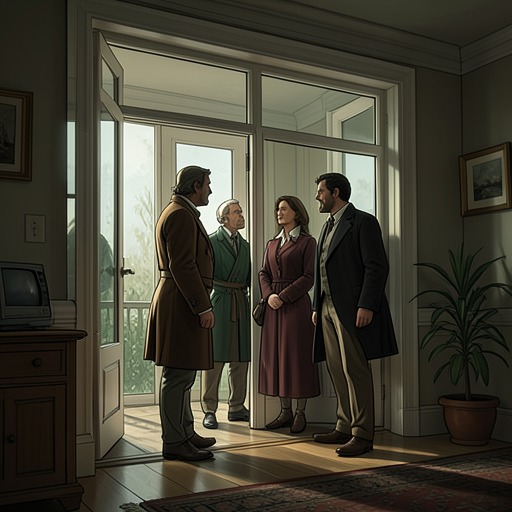
The letter arrives as typed pages that Hana carries, breathless, into the Glass Room during a ballet class. The room is occupied by girls and one androgynous boy, their postures likened to Degas dancers. Zdenka calls a five-minute rest and crosses to Hana in quick, bright skips, asking what has shocked her. Hana gives her the pages, but Zdenka cannot read German; she says she can barely pronounce auf Wiedersehn. The message therefore reaches the room first as a physical object and as Hana's visible alarm, before its contents can be shared.
Hana explains that the writer is Liesel Landauer, though she no longer uses that name. In America, the family changed it to Landor because Landauer was difficult for Americans to manage; Liesel now signs as Elizabeth Landor. The changed name registers a practical adjustment to a new country, but it also marks the distance between the woman Hana remembers and the correspondent writing back after years apart. The letter begins their reconnection under a name that is both hers and newly made for American use.
News of Blindness and a Shared Past
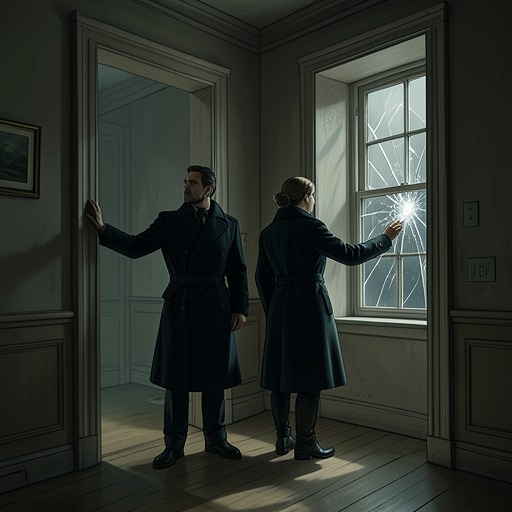
Hana reads the letter aloud and translates as she goes. Its first revelation is stark: Liesel has gone blind. The German sentence Hana points to, Ich bin blind geworden, lands in a room defined by light, reflection, and refraction. Nearby, the women’s reflections stretch along a curved chrome pillar. The room’s brightness does not soften the news; instead, the contrast makes the word blindness momentarily arrest the scene.
Liesel tells Hana that the condition has taken her through years of hospitals and clinics. Specialists in Boston use technical language, including idiopathic, without seeming to understand what has happened. She describes the blindness as apparently random, while wondering whether anything in life is truly more random than anything else. In the same passage she says that Ottilie helps her, rushing to her side when needed. The letter thus introduces both a serious change in Liesel's daily life and the care on which she now relies.
As Hana reads, the news breaks through her composure. She turns toward the conservatory glass, where ficus and cycads stand as they did in Liesel's time, and unexpectedly begins to weep. She tells Zdenka that she loved Liesel as she loves herself, and that their bond had made them feel like twins despite their differences. Hana names the relationship in its full complexity: they were friends and lovers, while Liesel was also a mother who loved Viktor. That complexity had always shocked Liesel, Hana says, but it does not make the attachment less real. The letter prompts Hana to speak aloud what years of separation have not erased.
An American Life, and Viktor's Death
Liesel reports that Viktor died in 1958 in a boating accident. After taking up sailing in Switzerland, he returned to it in America, this time on the ocean; the boat he was in capsized. The letter delivers the death with an apology for its casualness and uncertainty about whether Hana already knows. Its account makes the news both belated and intimate: Liesel explains the ordinary history of Viktor's interest in sailing alongside the abruptness of the accident that ended his life.
The family became American citizens in 1948, and that was when they changed Landauer to Landor. Viktor established Landor Marine in Falmouth, building small boats, including cabin cruisers and speedboats. Liesel still lives there with Ottilie and Ottilie's husband; she also has a grandson, Charlie, born after the accident, whom Viktor never knew. Martin lives in Boston and works successfully as a lawyer. These details sketch a family life that continued after exile and loss, while making Viktor's absence tangible in the next generation he did not see.
Liesel describes her own marriage to Viktor as marked by mutual dishonesty, though she says she always loved him in some way and that each had a separate life. She also discloses a later relationship with Piet, a Dutch employee of Viktor's company who was more than ten years younger. They were happy in a childlike way, and he called her his Czech mate. That relationship ended around the time of Viktor's accident. Liesel sets this personal history beside her remembered love for Hana, which she calls more intense and deeper than any other love she knew. The letter does not flatten these attachments into a single ranking: it lets Liesel acknowledge a life of overlapping loves, private compromises, and endings.
The House and the Invitation to Return
The letter's account of the present turns toward the house that Hana and Liesel once shared in memory. Liesel is glad that it has been preserved as a museum of some kind, though she dislikes the word museum: to her, the house is itself a work of art. She imagines it instead as a memorial to Rainer and Viktor, and in part to the self she once was. The house matters not only as a surviving building but as a place that contains the history of its makers and inhabitants, including a former version of Liesel that exile and time have made unreachable.
Liesel accepts the invitation to visit, while acknowledging that travel will be difficult for her and raising the political situation as a concern. Her willingness is therefore not a simple promise of return: it is an opening tempered by physical and political obstacles. She asks Hana to write and tell her everything, and signs herself as Hana's loving Liesel. The closing turns the typed pages into an appeal for renewed correspondence, leaving the prospect of reunion suspended between desire and practical difficulty.
Form and Significance
The letter is mediated twice: Liesel writes in German, and Hana translates as she reads to Zdenka, who cannot understand the original. Its typographical mistakes and stretches of scrambled letters make the act of reading imperfect even before translation begins. The pages cannot deliver Liesel's voice without obstruction; instead, Hana's effort to decipher and voice them becomes part of the encounter. The message is at once personal communication and a scene in which an absent friend is made present through reading.
Its revelations arrive in an order that repeatedly changes the emotional weight of what came before: a new name, blindness, Viktor's death, citizenship and family life, other loves, and finally the wish to see the house again. Hana's own response fills a silence the letter cannot bridge. As the pages reconnect the two women, the Glass Room—where Hana says she knew Liesel better than anywhere—becomes a setting for both recollection and confession. The house Liesel hopes to revisit is at once a possible destination, a memorial, and the measure of all the years in which the women could not share it.